
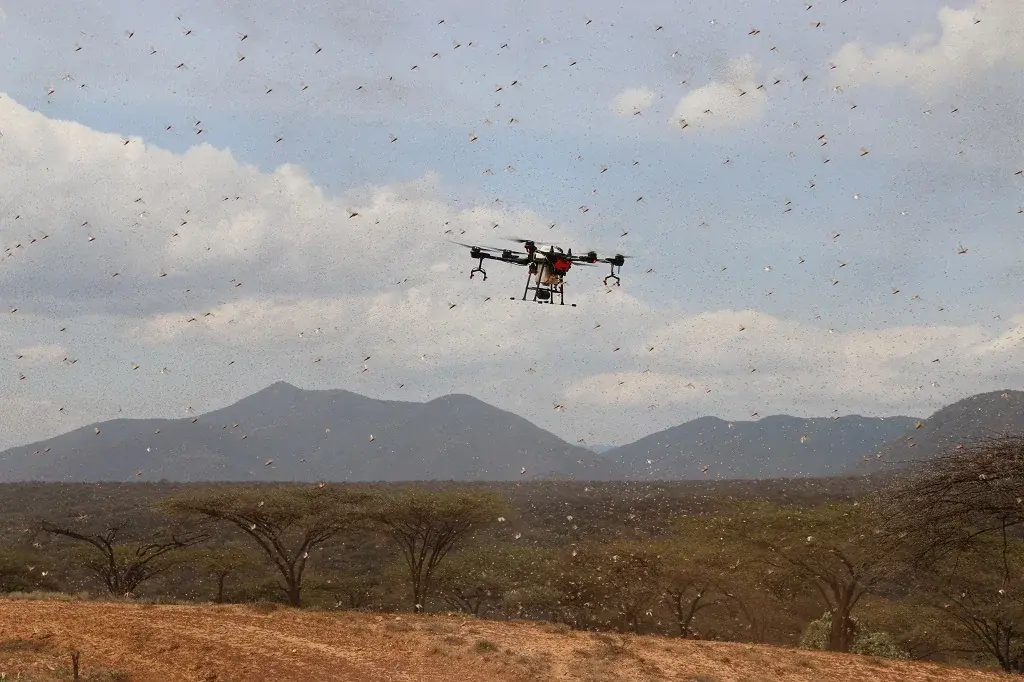
Drones in Locust Control: Putting Theory Into Action
Julie Makena · Head of Safety, Astral Aerial Solutions
7 December 2020 · 12 min read
The desert locust arrived in Kenya at a scale nobody in the region had planned for. Weather patterns across East Africa had created near-perfect breeding conditions, and by late 2020 at least seventeen of Kenya's forty-seven counties had confirmed infestations. Samburu, Turkana, Laikipia, Isiolo, Baringo and Elgeyo Marakwet took the worst of the first wave.
The arithmetic is unforgiving. A single desert locust eats its own body weight every day, roughly two grams. A swarm can hold hundreds of millions of them and travel 150 kilometres in a day. Left alone, the population in the affected counties could have multiplied several hundred times before the year was out.
Kenya's response leaned on what was available: over 216,000 litres of pesticide, fixed-wing aircraft, and ground teams working by hand. Both methods have a gap in the middle. Aircraft struggle with small or scattered swarms. Ground crews can't reach the valleys and hillsides where locusts prefer to roost. We thought drones could work that gap, spraying precisely where the other two couldn't go.
So Astral Aerial and CABI, the Centre for Agriculture and Biosciences International, went to find out.
We took two DJI Agras T16 spray drones. CABI brought Green Muscle, a biopesticide that is hard on locusts and gentle on everything else. The FAO's eLocust3m platform gave us tracking data. And we had a local scouting team who followed swarms into the night and could tell you which village they would settle on before they got there.
The plan was straightforward: test the technology properly, establish a scientific basis for the approach, and find out where drones actually fit.
Mission one: Maralal
Locusts roost at the end of the world. This is not a figure of speech. Our first drive out tested the limits of the 4x4s, and it was the easiest of the four.
We based ourselves at Maralal on the advice of the county officer, who considered it a strategic position for reaching roosting swarms. When the call came, the swarm was twelve kilometres from our strategic position.
By the following morning it had moved again, fifty kilometres out to Tepele in Wamba North. Fifty kilometres is nothing on tarmac. On murram road, with rain a real possibility, it is most of a day. We followed anyway, and found the swarm in a valley we could reach neither by vehicle nor on foot.
We put up a survey drone to assess the site and planned the spray from the imagery. The swarm was mostly immature locusts, pink, with a few mature ones mating among them. We ran the sprayer over them and waited. Activity slowed noticeably, but with the swarm moving and the biopesticide acting slowly, we couldn't measure a kill rate.
We tried again the next morning, starting earlier while the ground was still cool and the locusts too cold to fly. The roosting site at Ndoyo Nasipa had no road access, so we walked the last five kilometres carrying the drone, the batteries and the pesticide. Any fitness plans any of us had were comfortably met for the duration of the project.
At the site we found an aircraft scheduled to spray the same swarm. We waited until just before eleven, then worked through to midday on the swarm edges, supplementing the aircraft's coverage of the centre. We went low over tree tops, shrubs and ground clusters, then waited two hours to estimate mortality.
The lesson was about people, not aircraft. Response teams need open communication lines, or we all spray the same ground twice.
What we learned
- Coordination with ground teams decides whether an operation works.
- Pilot skill and site selection matter enormously in extreme terrain. Take-off and landing options shape how much you can spray.
- Once locusts lift off, spraying is pointless. The roosting window is everything.
Mission two: Rumuruti and Churo
We set out for Marigat on the first of October. The swarm site turned out to be inaccessible on security grounds, so we waited in Nakuru for the scouts.
They sent us to Rumuruti, where we arrived mid-morning to an immature swarm spread across roughly 400 acres of flat, loamy ground. It was about to fly. Spraying a swarm in flight is both ineffective and unsafe, since hundreds of locusts will jam a drone's rotors and bring it down. We waited and followed.
The swarm moved ten kilometres, from a village called Survey to Nagum, and the roads cost us enough time that it was moving again when we arrived. We sprayed what remained, covering 1.63 hectares at twelve metres height with ten metre line spacing, averaging 5.8 minutes per flight, and collected samples.
At Kiwanja Ndege in Churo the locusts were roosting on acacia canopy and on the ground across some 800 acres. We mixed the solution and sprayed 4.96 hectares over fourteen flights and 55.45 minutes of flight time, working through different flight modes and varying spray heights and rates as we went.
The kill rate came back lower than we wanted. That was disheartening, and it was also the point of the exercise. We packed up and went back to Nairobi to work out what to change.
What we learned
- Spray height has to be set from the vegetation, not from a manual. Here the locusts were on the top canopy of tall trees.
- Flying 2.5 metres above the canopy covered the tree tops properly.
- The downdraft from the rotors pushed pesticide through the canopy to the locusts sheltering underneath.
- Flying lower controlled drift and wasted less liquid.
Mission three: Maralal again
The third trip felt scripted by comparison. Easy site access, flat ground, wind low enough for the spray to settle where we put it.
We flew a survey drone first and picked a four hectare target. After calibration we sprayed at 250 millilitres per minute across four nozzles, a litre a minute in total, then varied speed, rate and height to find the effective combination. Measured swath width came out at six metres, three either side of the aircraft. We netted sprayed locusts to check mortality a few hours later.
The next day brought no sightings at all, and the day after that we drove home. Locusts do not keep appointments.
The real lesson arrived as we packed up, when the actual centre of the swarm flew over us. We had been spraying its outer edge. Better scouting went into the plan for the next trip.
Mission four: Baragoi
Baragoi was dealing with cattle rustling when we arrived. A special branch officer had been killed in an attack the night before, and we had a police unit on our hotel overnight. This project tested a few limits we hadn't anticipated.
We drove an hour and a half the next morning and got as close as a riverbed two kilometres from the roosting site. The rest was uphill on foot: five batteries at five kilos each, an 18.5 kilo drone, chemicals, and sixty litres of water. The swarms were so far into the hills that the communities were using smoke signals to mark the roosting sites.
The locusts were hoppers, too young to fly, spread across multiple swarms of about a hectare each. There was no clear take-off area, so we cleared shrubs to make one, collected pre-spray samples, sprayed, and collected post-spray samples. Rain was coming and we had a two kilometre walk back with no food or water. It held off until we were down.
The second day's site was a four hundred metre walk, which felt like a courtesy.
What we learned
- Swath width tests at varying heights, run with Violet Ochieng of the University of Nairobi, showed clearly that lower altitudes gave better penetration and less drift.
- Hoppers are the best target. They stay put, and they cluster in small groups across wide areas. Flying close to them worked even in thick bush and rocky ground.
- Assisted manual mode suited this environment best: set the height, speed and line spacing, fly the swarm manually.
- eLocust3m helped, but network coverage gaps left data stale in places. Radio is more reliable. Not every scout carries a smartphone.
- The community reporting chain is genuinely good. Scouts are trained to identify desert locust, they know what to report, and they know who to call.
Where this leaves us
A survey of affected Kenyan counties found an average of 77% of crops severely damaged and 70% of free-range grazing land affected. That is the number this technology has to move.
Across four missions we established that a single drone achieves a six metre swath with the right height, spacing, mode and speed. That works. What it doesn't do yet is cover ground fast enough to matter at national scale.
Two things need to change. We need a better understanding of biopesticide concentrations within safe environmental limits, and we need deeper penetration, which we believe means moving to ultra low volume spray technology. And we need standard operating procedures shared across drone, aircraft and ground teams so the three complement each other instead of duplicating.
No single method solves this. That was the clearest finding of all.
First published by the Frontier Tech Hub, in partnership with the UK Foreign, Commonwealth and Development Office. Read the original
Working in the Kenyan drone industry since 2017, across regulation, field operations and safety management.
End-to-end aerial solutions, flown to aviation standard.
Get in touchWant to build that pilot skill yourself? See our drone pilot training.