
Building a ULV Spray Drone From Scratch
Julie Makena · Head of Safety, Astral Aerial Solutions
27 April 2021 · 6 min read
With locust activity easing across the region, we stepped back from the field to work on what the field had told us.
The message from four missions was simple enough. Our spraying worked, but not fast enough. To be genuinely useful alongside aircraft and ground crews we had to cover far more ground per flight. That left two options: longer flight times, or better spray technology. Several stakeholders running spray operations, the FAO among them, pointed us at the same answer. Ultra low volume.
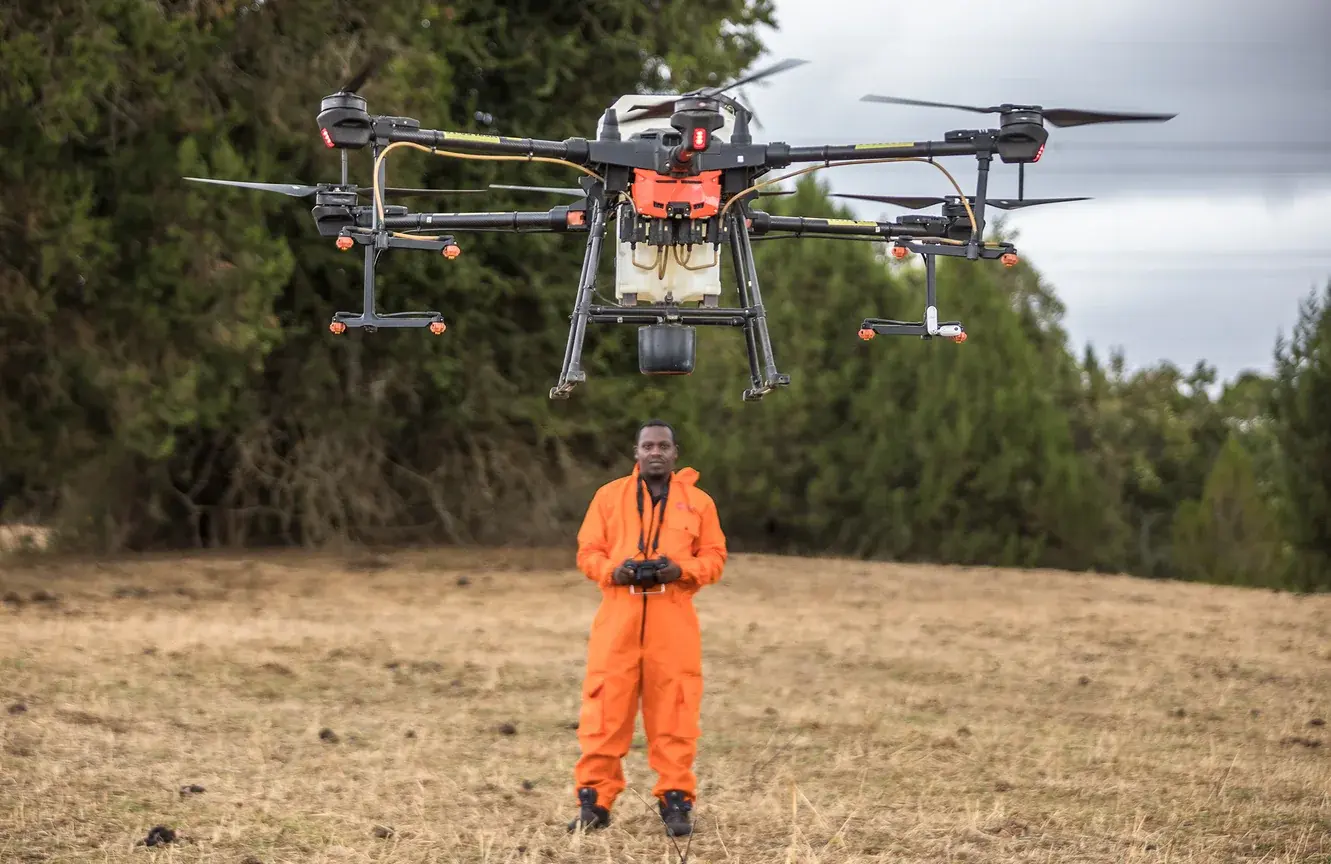
The DJI Agras T16 is a capable sprayer as it ships. But it uses emulsifiable concentrate, which is mixed with water, and which we classify as medium to low volume spraying. In practice that meant covering a hectare in ten to twelve minutes.
The water was the bigger problem. Remote roosting sites don't have any, and several of them had no road either. We had carried sixty litres up a mountain on foot more than once. Anything that removed water from the equation would change the logistics of every mission.
ULV does exactly that. A brushless motor atomiser produces much smaller droplets, closer to a mist, which penetrate better and need far less liquid. Operators already using it reported covering a hectare a minute with a litre of chemical. The formulation is sticky, which makes it more effective on the target, and Green Muscle performs better in ULV form. On the manufacturer's figures we were looking at up to a sevenfold improvement.
Nobody sells one
We went looking for a drone with ULV capability and discovered there wasn't one on the market. Buying was not an option, however open to it we were.
So we decided to build it. We had the drone, we knew where ULV sprayers came from, and we were reasonably confident in ourselves.
The build
We sourced the ULV system from Micron, who pioneered the technology. They part-assembled a lightweight nozzle in Europe. Everything else, the build, the integration and the testing, happened in Nairobi, led by Allan Mwanzia, who runs the technical side at Astral.
Allan sourced the electrical components locally. The boom that holds the nozzles came from a junkyard: an aluminium window channel, which was exactly the right thing.
The team worked through manuals, white papers, videos and long conversations with advisors. It was a steep curve over a short period.
We assembled the potentiometers, connected the system to the drone's pipe supply and spray tanks, and powered it from batteries. Our main worry was battery drain, particularly running four or five sprayers at once. In testing, consumption turned out low enough to spray for several hours on one charge.
To power the assembly in flight with as few additional systems as possible, we reduced the chemical pipes from four to one feeding the sprayers. That divided chemical usage by four while increasing the area covered per flight.
We added a shunt on the supply pipe that returns some chemical to the tank. Oversupplying the ULV discs enlarges the droplets, which defeats the purpose.
Then we integrated the whole thing onto the T16, working carefully around anything that would void the drone's warranty. Sprayers and battery were balanced to hold the centre of gravity, and we ran build quality checks to make sure nothing shifted in flight.
We deliberately kept the new system independent of the drone's own electronics. The original spray setup still has a job on farm work, and we wanted both.
The ULV assembly hangs on a three metre boom powered by a one kilogram lithium battery, so before any field test we ran static and hover tests to confirm the aircraft was balanced and controllable.
What we have now
A working ULV-equipped spray drone, built in Nairobi.
That is one hurdle cleared. The next is testing it in varied conditions and measuring what it actually does. A sevenfold efficiency gain would change the role drones can play in locust response, both by covering more ground per flight and by reaching places aircraft cannot.
It also opens up questions we can't answer yet. Other pests. Different chemicals. Denser formulations the original system couldn't handle. Quelea birds are already on the list.
We have a lot of testing ahead.
First published by the Frontier Tech Hub, in partnership with the UK Foreign, Commonwealth and Development Office. Read the original
Working in the Kenyan drone industry since 2017, across regulation, field operations and safety management.