
Testing ULV Spraying in the Real World
Julie Makena · Head of Safety, Astral Aerial Solutions
26 November 2021 · 10 min read
The hardest problem in the drone industry is not technical. It is perception.
Drone operators spend a lot of time correcting two opposite errors. One reduces the technology to a toy. The other expects far too much of it. I was recently asked about a drone that could run security surveillance from Nairobi to Mogadishu. All ideas are welcome, but it helps to pace the imagination against where the industry actually is.
Progress is a slow process, and everyone in the sector contributes to it: regulators, operators, and the people running experiments to find out what works. Experimentation is how we get to reliable operational procedure.
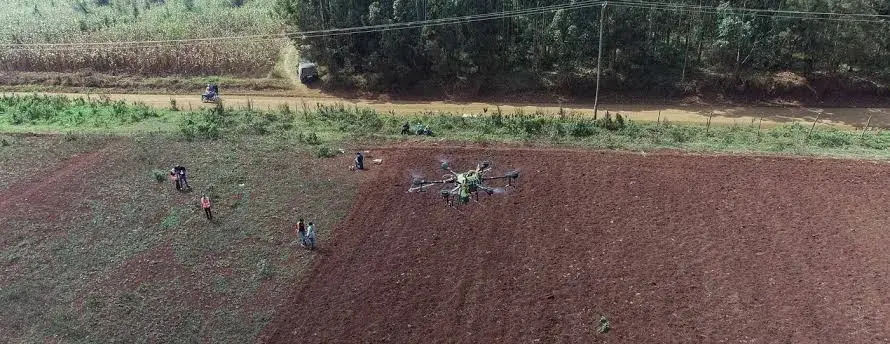
That has been our route with desert locust control. We carried spray drones into some of the most remote country in Kenya, took the aircraft back to the workshop to fit ultra low volume nozzles, and then brought it back out to find out whether the modification held up. This time to Muguga farm in Kiambu county.
What we were testing
Two objectives. First, the optimum parameters for tracking locusts with surveillance drones. Second, the efficiency of the ULV sprayer and the best spray height.
CABI ran the science with us. Their team bred the locust samples and interpreted the results.
Getting ULV to work properly matters for a specific reason. Our goal has always been to supplement existing disaster response, not replace it. Aircraft and ground spraying are the established methods, and both struggle with difficult terrain. Drones can fill that gap, but only if their spraying is as effective as the methods they are supporting. Matching the spray technology used by aircraft and ground teams is what makes results consistent regardless of which asset does the work.
Surveillance matters for the same reason. Roosting sites sit in poor terrain, with no infrastructure, often scattered across a wide area. A drone can find and map them, which is what makes accurate flight planning possible for the spray run that follows.
And the timing is unforgiving. Locusts travel hundreds of kilometres a day, following unpredictable wind. Finding a roosting swarm or a breeding site full of hoppers is a narrow opportunity that does not come back. There is no room to get the spray parameters wrong on the day.
Setup
The test site was a one hectare parcel. We used live and dead locusts held in cages and tins, distributed across the field in clusters at varying intervals, arranged into test and control groups.
For surveillance we flew a DJI Phantom 4, shooting 1080 stills and 4K video. For spraying, the ULV-integrated Agras T16, with its spray boom, Y-piping for chemical supply and a 10,000 mAh LiPo battery.
Mapping
We flew the Phantom on a fixed flight path at 30, 35, 40, 45, 50 and 75 metres above the targets. Those targets were a thousand preserved locusts spread across two half-acre fields, one grassland and one roughly 80% bare ground. The imagery was processed into orthomosaics at varying resolutions for analysis.
In the field, forty metres felt like the sweet spot. Fewer obstacles, higher safe flight speed.
The analysis disagreed, in a useful way. Seventy-five metres gave the best overall result at 2.05 cm per pixel. Lower flights produced higher resolution, but at 75 metres the imagery was still clear enough to identify swarm location, approximate size and life cycle stage, while covering far more ground per flight.
Spraying
Live locusts in cages were sprayed with metarhizium, the biopesticide also known as Green Muscle, and with fenitrothion for separate groups. The Agras flew the same five heights on the same path.
Watching that aircraft lift off with the ULV boom fitted, flight after flight, was a good moment. Taking an industrial sprayer from its manufactured state and rebuilding its spray system while keeping power, liquid supply and flight controls intact is a different order of problem from operating one.
After spraying, the locusts went back to CABI's lab for observation of mortality and fungus growth.
Results
Coverage. One hectare in five minutes with ULV, against ten minutes with emulsifiable concentrate. Half the time. And the test area was small, so a meaningful share of each flight was spent turning the aircraft from one line to the next. On a larger area the rate would improve further.
Spray rate. 900 millilitres per minute, 300 per nozzle.
Battery. A considerable increase in flight time.
Mortality. Higher when the drone flew lower.
To verify the numbers we repeated the whole exercise at the same farm in comparable weather, this time using paper. Hundreds of sheets pinned to the ground at one metre intervals in three rows spaced thirty metres apart. We sprayed water soluble ink from the Agras, with and without the ULV system, across all five heights, unpinning and replacing the sheets after every run, three times at each height.
Those sheets give us swath width, droplet density and coverage area, and with them the optimum spray height with and without ULV.
What it means
Muguga was a first verification, not a conclusion. But the direction is clear: better surveillance workflow, better spray rate per nozzle, and a higher coverage rate that translates directly into more ground covered in the same roosting window.
The experiments also showed how much wind matters. Strong wind carried the chemical further, which helps spread but raises a question about penetration that the paper analysis will answer. For the pilot, the practical lesson is to stay aware of wind pattern throughout the spray and use the extra drift rather than fight it.
Further out, this points to something larger. Drones deployed automatically to collect imagery on swarm location and size. That reconnaissance feeding strategic positioning of every available asset, aircraft, ground sprayers and drones, so that more swarms are controlled inside a single roosting period through properly synchronised effort.
Progress is a process. This part of it lays a foundation for evidence-based drone operations in locust control and in the management of similar pests. Given what these invasions cost in food security and livelihoods, it is worth the work.
First published by the Frontier Tech Hub, in partnership with the UK Foreign, Commonwealth and Development Office. Read the original
Working in the Kenyan drone industry since 2017, across regulation, field operations and safety management.